The board member's question was simple: "What's our customer acquisition cost by segment?"
The CEO looked at the CFO. The CFO looked at the VP of Sales. The VP of Sales looked at the table.
"We can get that to you by next week."
It was the third time that meeting someone had promised to "get back to" the board. By the fourth, the lead investor stopped asking questions altogether. Not because he'd run out—because he'd lost confidence that anyone in the room actually knew how the business worked.
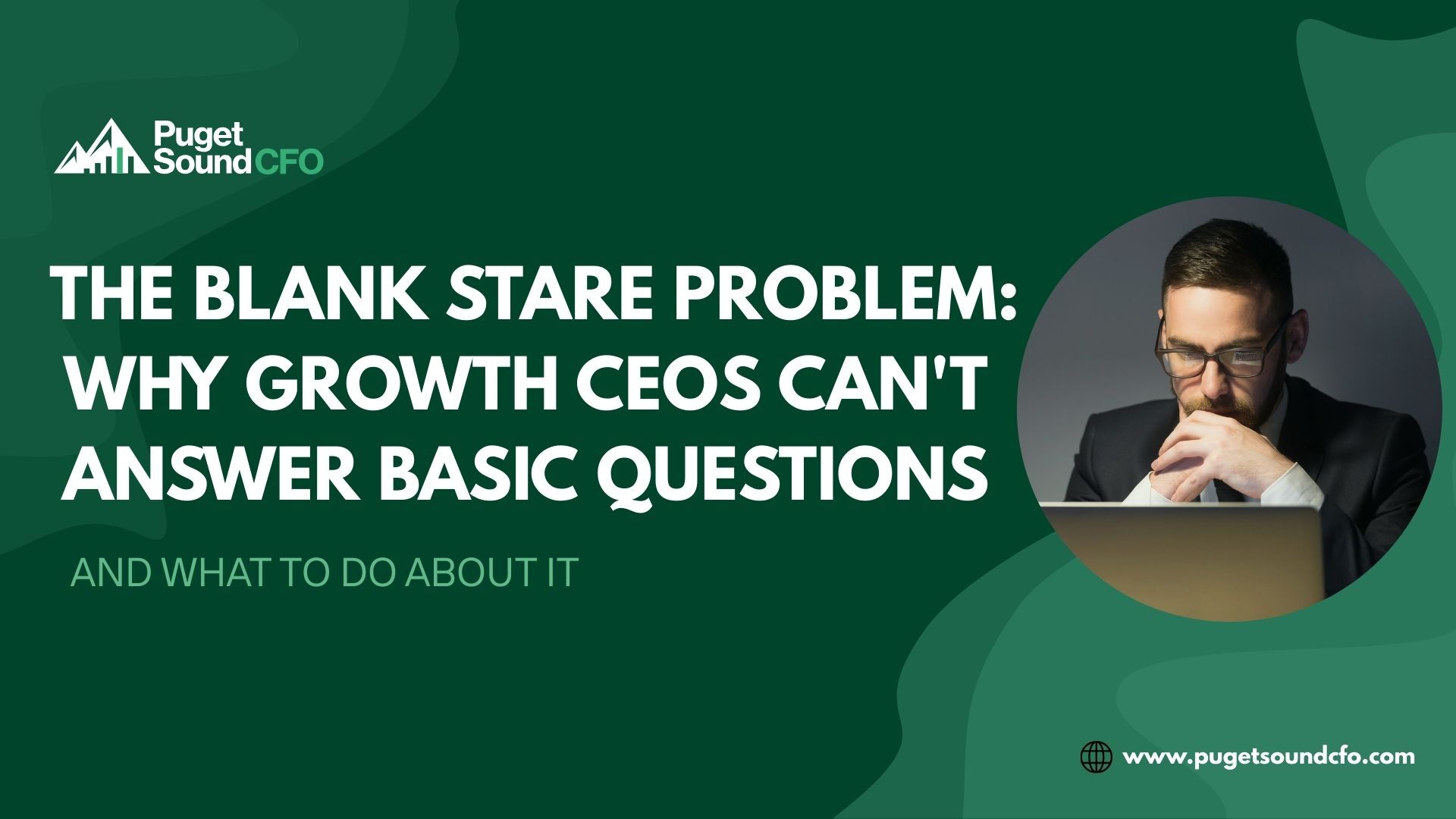
This is the blank stare problem. And if you're running a growth company, you've either experienced it or you're about to.
The Anatomy of a Blank Stare
The blank stare isn't about intelligence. The smartest operators in the room give blank stares every day. It's about infrastructure—or the lack of it.
Here's how it happens:
The question lands. "Can we afford to hire two more engineers?"
The mental calculation begins.Let me think... what's our current burn... what's our runway... what's loaded cost for engineers in Seattle... what does the forecast show... wait, when was the forecast updated...
The stall. "That's a great question. Let me pull some numbers and circle back."
The archaeology project begins. Check the P&L (two weeks old). Check the cash balance (yesterday, maybe). Check the forecast (last updated for board meeting six weeks ago). Check the comp data (is that spreadsheet still accurate?). Email finance. Wait for response. Build a model. Pressure-test assumptions. Schedule a follow-up meeting.
Three days later: "Based on my analysis, I believe we can support one hire in Q2, with the second contingent on hitting revenue targets."
By which point the candidate has taken another offer, the market has shifted, and the question has become irrelevant.
The Real Cost of Blank Stares
Blank stares aren't just embarrassing. They're expensive.
Cost #1: Decision Velocity
Every blank stare is a decision delayed. Every decision delayed is an opportunity window narrowing. Your competitors aren't waiting three days to answer basic questions. They're moving while you're researching.
The math is brutal: if you make decisions 50% slower than competitors, you need to be 50% smarter to keep pace. Most companies aren't.
Cost #2: Leadership Credibility
Boards notice. Investors notice. Your own team notices.
When leadership can't answer basic questions about the business, it signals one of two things: either they don't know (competence problem) or the systems don't exist to know (infrastructure problem). Neither interpretation builds confidence.
I've watched funding rounds cool because investors lost faith during due diligence—not over the numbers themselves, but over how long it took to produce them.
Cost #3: Compounding Uncertainty
Blank stares breed more blank stares.
When you can't answer "What's our CAC by segment?" you also can't answer "Which segments should we prioritize?" Which means you can't answer "Where should we allocate marketing budget?" Which means you can't answer "Can we afford this campaign?"
One missing insight creates a cascade of unanswerable questions. The uncertainty compounds until every strategic discussion becomes an exercise in educated guessing.
Cost #4: The Archaeology Tax
Every time someone stops their actual work to dig for data, you're paying the archaeology tax.
Your VP of Finance spending 15 hours building a board deck from scratch—that's archaeology tax. Your CEO asking three people the same question to triangulate an answer—archaeology tax. Your leadership team debating numbers instead of strategy—archaeology tax.
The archaeology tax is invisible but relentless. It consumes your highest-paid people's time on work that shouldn't exist.
Why Smart Companies Still Have This Problem
If blank stares were just about incompetence, they'd be easy to fix. Hire better people. Problem solved.
But the blank stare problem isn't about people. It's about systems—and the gap between operational complexity and financial infrastructure.
Your Business Grew. Your Financial Operations Didn't.
At $2M in revenue, you can hold the whole business in your head. You know which customers matter. You know roughly what things cost. You can estimate runway by checking your bank balance.
At $15M, none of that works anymore.
But the systems you built at $2M—the spreadsheets, the manual processes, the quarterly reviews—are still the systems you're running. The business evolved. The infrastructure didn't.
Data Exists in Silos
The answer to most questions exists somewhere. It's in the CRM. Or the accounting system. Or the HRIS. Or that spreadsheet the VP of Sales maintains. Or the one the controller built for a board meeting last year.
The data exists. What doesn't exist is a way to access it without an archaeological expedition across seven systems that don't talk to each other.
Reports Look Backward
Most financial reports are autopsies. They tell you what happened, not what it means
You can see last month's revenue. But can you see which customers are profitable? You can see last month's expenses. But can you see which departments are over-burning? You can see last month's cash flow. But can you see next month's?
Backward-looking data answers backward-looking questions. But leadership asks forward-looking questions.
Knowledge Lives in Heroes
In every organization with blank stare problems, there's a hero. Someone who knows where everything is. Someone who can produce any report if you give them enough time. Someone the whole company depends on for answers.
This is a liability disguised as an asset.
When knowledge lives in heroes instead of systems, you're one resignation away from total blindness. You're one vacation away from paralysis. You're scaling a business on a foundation that can't scale.
The Questions You Should Be Able to Answer Instantly
Here's a diagnostic. Time yourself answering these questions—not with rough guesses, but with actual data you'd stake a decision on:
Cash Position
-
What's our cash balance right now?
-
What's our burn rate this month versus last month?
-
How many weeks of runway do we have at current burn?
-
How does that change if we hit plan versus miss by 20%?
Customer Economics
-
What's our CAC by channel?
-
What's our LTV by customer segment?
-
Which customers are profitable? Which are underwater?
-
What's our payback period, actually?
Operational Health
-
What's our revenue per employee? How has it changed?
-
Which departments are over budget? By how much?
-
What's our close rate trending? Is it improving or declining?
-
How does this month compare to same month last year?
Forward View
-
What's our forecast for next quarter? Next year?
-
What are the key assumptions in that forecast?
-
What happens if we lose our biggest customer?
-
Can we afford the hires we've planned?
If any of these take more than 60 seconds, you have a blank stare problem.
If most of these take more than a day, you have a serious blank stare problem.
If some of these you simply cannot answer, you're making significant business decisions blind.
The Fix: Intelligence Rhythm
The blank stare problem is the third of three challenges we see in every growing company—alongside getting ambushed by cash surprises and growing broke as revenue rises.
The solution is what we call Intelligence Rhythm: the systems, dashboards, and processes that convert data into answers at the speed of conversation.
What Intelligence Rhythm Looks Like
Real-time dashboards that answer questions before they're asked.
Not dashboards that show everything. Dashboards that show what matters. Leadership-level views that answer the questions boards and investors actually ask. Operational views that let department heads manage without waiting for finance.
Profitability visibility by customer, product, and segment.
Not just revenue. Not just margin. Actual profitability that accounts for true costs—including the costs everyone forgets to allocate. This is how you know which customers to acquire more of and which to quietly let churn.
Forward indicators that show what's coming.
Trailing metrics tell you where you've been. Leading indicators tell you where you're going. Pipeline velocity. Booking trends. Churn signals. Cash flow forecasts. The difference between managing reactively and managing proactively.
A single source of truth.
No more reconciling three spreadsheets that should match but don't. No more "my numbers show something different." One system of record that everyone trusts because everyone uses.
What Changes When Blank Stares End
When Intelligence Rhythm is operational, meetings feel different.
Questions get answered in the room where they're asked. Debates shift from "what are the numbers" to "what do the numbers mean." Decisions happen at the speed of opportunity instead of the speed of archaeology.
Board meetings become strategic discussions instead of data-gathering exercises. Leadership team meetings become decision-making sessions instead of status updates. Your best people spend their time leading instead of researching.
And perhaps most importantly: you stop dreading the questions. You start welcoming them. Because every question is an opportunity to demonstrate that you actually know how your business works.
The 90-Day Path from Blank Stares to Instant Answers
Blank stares don't fix themselves. But they also don't require years to solve.
In the Financial Rhythm System, Intelligence Rhythm is the third rhythm we install—after Foundation Rhythm establishes visibility and Planning Rhythm creates foresight.
By day 90, the transformation is measurable:
| Question Type | Before | After |
| Cash Position | "Let me check" | Instant, real-time |
| Customer Profitability | "We don't really know" | By segment, updated weekly |
| Runway Scenarios | 3-day analysis | Pre-built, what-if ready |
| Board Questions | 72-hour fire drill | Same-day answers |
| Decision Support | Gut feel + hope | Data-driven, confident |
The companies that make this transformation don't just stop giving blank stares. They start asking better questions—because they know they can actually answer them.
The Uncomfortable Question
Here's what most CEOs don't want to admit: the blank stare problem isn't new.
You've known for months—maybe years—that you couldn't answer basic questions about your business. You've felt the pause before admitting "I'll get back to you." You've watched opportunities pass while waiting for data.The discomfort isn't in admitting the problem exists. It's in admitting how long you've tolerated it.
The question isn't whether you have blank stare problems. The question is how long you're willing to keep having them.
Stop the Blank Stares
The blank stare problem is solvable. Not with more spreadsheets. Not with another dashboard project that nobody uses. Not with heroic effort from your finance team.
With systems. With rhythm. With infrastructure that scales.